
Forest Management
The Kraemer Tower doesn’t stand alone. It sits at the high point of the Sullivan Family Tree Farm — 211 acres of actively managed timberland west of Pedee, Oregon, in Polk County. The tower is one piece of how the property gets looked after.
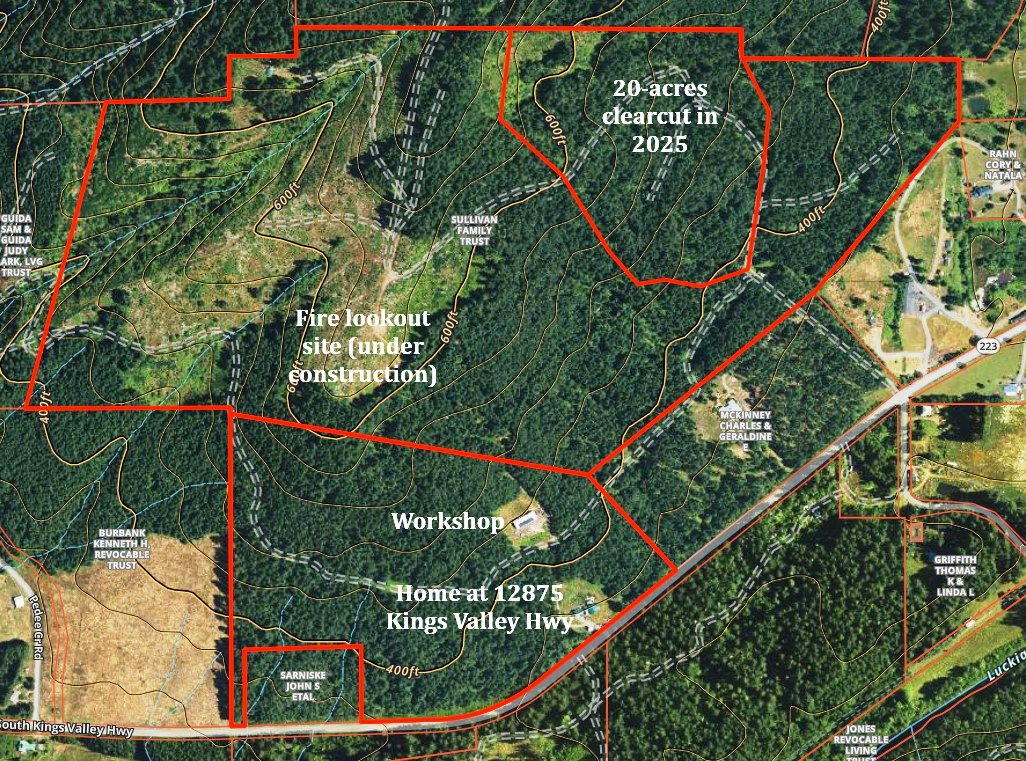
September 2026: redwoods and the first survival check
Coast redwood plugs were planted in 2026. The immediate forest task is to establish the completed planting record and survey first-summer survival before choosing replacements. Start with the clear-cut and redwoods, then Eli’s survey and field packet and the replacement plan. The acreage and completed planting tally remain to be verified.
The property
- 211 acres total (209 acres forested).
- Held by the Sullivan Family Revocable Trust.
- West of Pedee, north of Highway 223 (Kings Valley Highway). The mobile home at 12875 Kings Valley Highway sits on roughly two acres at the property’s southeast entrance; the tree farm is everything above it.
- Watershed: the west side drains into Pedee Creek, a tributary of the Luckiamute River. The east side drains directly into the Luckiamute.
- Topography: 10% flat, 75% gentle slope, 15% steep slope. Most of the property is south-facing.
- Roads: about a mile of graveled main road, another mile and a half of dirt road maintained for harvest access.
The property has been continuously in active forestry for more than half a century. Publishers Paper planted Douglas-fir on the open areas around 1976. WTD Industries clear-cut what remained in 1989. Dave Sullivan and his then-wife Janet Schmidt bought the property — bare and unreforested — from WTD in December 1989, for roughly $300 an acre.
In the winter of 1990, Dave personally planted about 25,000 Douglas-fir seedlings and supervised Oregon State University Floor Hockey Club volunteers who planted another 25,000. He had the property aerial-sprayed for grass control in the summers of 1990 and 1991. In 1991, the Oregon Small Woodland Association named Dave the Polk County Tree Farm of the Year.
That’s the foundation everything since has been built on.
The plan
The property has been operated under a written forest management plan since September 2012, with a formal update in February 2022 after the February 2021 ice storm broke the tops of a large share of the older Douglas-fir. The plan author across both versions is Russ Anderson of Evergreen Forestry Consulting in Philomath, working originally with Jerry Witler as Technical Service Provider.
The plan is a real document. It certifies the property under:
- The federal Forest Stewardship Program (USDA / Oregon Department of Forestry).
- The USDA NRCS Environmental Quality Incentives Program (EQIP).
- The American Tree Farm System (ATFS) — the country’s oldest woodland certification program, originally chartered to recognize working forests held in private family ownership.
Each certification carries an inspecting forester’s signature and a tracking number. The 2012 plan runs 38 pages with formal appendices on soils, harvest schedules, planting job sheets, slash treatment, and trails and landings.
The plan treats the property as five stands — five separately-managed areas defined by stand age, species mix, and stocking density:
| Stand | Acres | Planted / age in 2026 | Current state |
|---|---|---|---|
| A | 62 | Publishers Paper, 1976 (~50 yrs old) | Fully stocked Douglas-fir, scheduled for final harvest around age 55 (≈2031). |
| B | 106 | Dave Sullivan, 1990 (~36 yrs old) | The biggest stand. Variably stocked Douglas-fir interspersed with big-leaf maple sprouts. Final harvest planned around age 55 (≈2045). |
| C | 13 | Started ~1965 (~61 yrs old) | Mature Douglas-fir and grand fir. Harvested in the 2025 Treeline operation. |
| D | 5 | Started ~1965 (~61 yrs old) | Mature Douglas-fir, grand fir, and big-leaf maple. Harvested in the 2025 Treeline operation. |
| E | 25 | Failed 1990 planting | Big-leaf maple, ocean spray, Oregon cherry, blackberry. To be salvaged and converted back to a conifer plantation when chip prices support it. |
The goal — and the saying behind it
The 2012 plan states the goal plainly:
Dave Sullivan has a long-term view of timber management, and his first and overriding priority is: maximize the property’s net present value through intensive forest management. Dave believes in active management and wants the property to produce as much value for society as possible.
A substantial share of Dave and Barb’s net worth sits in this 211 acres. The old saying — don’t put all your eggs in one basket — has a counter from people who actually run things: put your eggs in one basket and then watch the basket. That’s the operating philosophy here. The plan, the periodic updates, the certifications, the regular harvest schedule, and the fire lookout tower are all instances of watching the basket.
Active management means: thin where it improves the stand, harvest when stands are mature, replant promptly, control competing brush, maintain the road system, and protect against fire. It does not mean: maximize immediate cash. The plan explicitly rejects the “consistent stream of small income” approach in favor of grouping major operations (harvest, replant) to lower per-acre setup costs.
Recent harvest — the 2025 Treeline operation
In January 2025, Dave contracted with Treeline Logging LLC (owned by Russell and Cody Robertson, Monmouth) for the final harvest of approximately 18 acres of 46-year-old Douglas-fir — Stands C, D, and parts of A — with an estimated volume of 400–500 thousand board feet (MBF). Harvest ran February 1 through March 31, 2025.
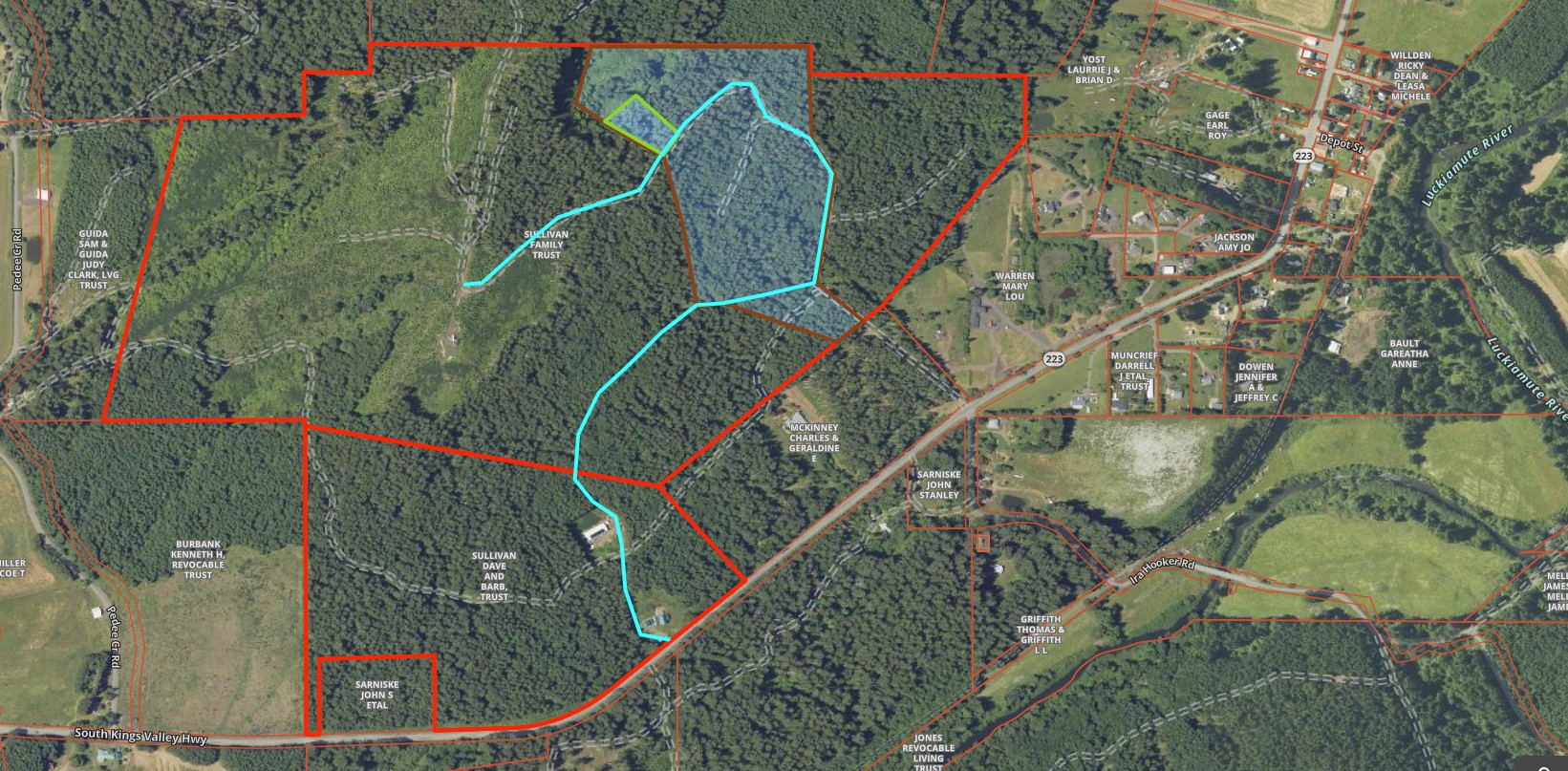
The 2025 operation also funded the resumption of the long-paused tower build — see the Solid Rock page for the financial-bridge narrative.
Who bought the logs. Dave handles mill selection and log marketing; Treeline focuses on the cut, the buck, the yard, the load, and the haul. The 2025 sort went mostly to two buyers:
- Hampton Tree Farms, LLC / Willamina Lumber Co. (Salem) — the primary mill for the larger sawlogs. Hampton operates under the Sustainable Forestry Initiative. Most of the 2025 volume went here.
- Fibre Marketing, Inc. (Corvallis) — the pulp buyer. Alder and maple utility wood at $23/ton delivered; conifer utility at $32/ton delivered. Pulp permit 2025-561-00790, effective March through September 2025.
The cut-to-length method used in 2025 — a feller-buncher to drop and bunch the trees, a tracked processor to delimb and buck to length on the spot, a shovel logger to forward and load — left the harvest area in good shape for replanting. Dave handles the slash and ground prep with an L2501 tractor (grapple) and a Kubota mini-excavator. The 2026 work moved to coast redwood plugs; see the planting record for what is confirmed and what remains unresolved.
Fire protection — and where the lookout fits
The 2012 management plan handles fire protection in two layers.
Layer one — outside services. The Sullivan Family Revocable Trust pays its annual assessment to the West Oregon Forest Protection Association (WOFPA). That assessment funds, across the WOFPA region:
- Ground patrols during fire season.
- Aerial reconnaissance during periods of high fire danger.
- Initial response from the Oregon Department of Forestry on any fire start.
- Back-up wildfire fighting teams for serious activity.
Layer two — what the landowner adds. The plan then lists five supplemental measures it recommends every certified tree farm consider:
- Access roads brushed, graded, and signed so firefighters can find each road.
- A copy of any gate keys provided to the Oregon Department of Forestry office in Dallas.
- The nearest off-site water source identified for filling fire engines and tankers.
- Opportunities to develop on-site water sources identified and possibly developed.
- Consider purchasing a small fire trailer with pump and hose for initial attack on small fires.
The Kraemer Tower is part of that second layer. A staffed lookout at the highest point on the property gives early-detection eyes on the entire 211 acres and on neighboring timberland — the kind of supplemental protection the plan explicitly recommends.
The lookout’s role is observation: spot a smoke plume early, triangulate it on the Osborne Fire Finder at the top of the tower, and get the call into ODF Dallas while initial response is still on the table. That’s the historical job of every fire lookout in Oregon — the difference is that this one is on private timberland that’s actively managed under a federal stewardship plan.
The property has no recorded history of wildfire (per the 2012 plan). The plan’s verdict: the property was used for pasture during the first half of the 20th century, so evidence of prior wildfires would have been removed when the pasture was created. Today’s risk profile is the risk profile of any working Douglas-fir stand in the Coast Range foothills — manageable, but not zero, and getting more attention as Oregon’s fire seasons lengthen.
What’s coming
The plan’s near-term workstreams, in roughly the order they come up:
- 2026 planting and survival check — The earlier plan proposed 75% Douglas-fir / 25% grand fir at roughly 250 trees per acre. Coast redwood plugs were subsequently planted. That earlier prescription is historical, not a current planting instruction. Complete the stocking survey and review the replacement plan before a new order.
- Stand A pre-commercial thinning — the 2022 plan update modeled an earlier final harvest for Stand A (around 2032) given the ice damage to the smaller-diameter trees.
- Stand E conversion — when the hardwood chip market clears $30/ton (the break-even price), Stand E gets salvaged and replanted as a real conifer plantation.
- Stand B periodic monitoring — Dave’s 1990 planting now in its mid-thirties, with a final harvest around 2045 if current rotation modeling holds.
- Fire-detection capability — the lookout tower completes the second layer of fire protection.
The documents
The full management plan, the 2022 update, the 2025 Treeline agreement, the Hampton and Fibre Marketing purchase orders, the property maps, the ATFS Tree Farm certification, and supporting historical contracts are all filed in the project’s primary-source archive. They’re not posted on this site at present — the website is a coordination tool for the active build, and the management plan itself isn’t on the build’s critical path. They’re available on request from Dave.
Sources for this page: SullivanPlan-Final_Signed (2012), SullivanTreeFarm Mgt Plan - 2022 (the update), the 2025 Treeline Logging Agreement signed January 25, 2025, the Hampton Tree Farms purchase order, the Fibre Marketing pulp PO (forest permit 2025-561-00790), the Sullivan Treefarm Tour notes from February 9, 2025, and the ATFS Tree Farm Certification.